API clients aren’t just tools anymore—they’re collaboration hubs, version-controlled artifacts, and first-class citizens in modern DevOps pipelines. As teams demand tighter Git integration, reproducibility, and auditability, a quiet but powerful migration is underway: developers are ditching Postman for Bruno. Here’s why—and what it means for your workflow.
1. The Git-Native Revolution: Why Version Control Is No Longer Optional
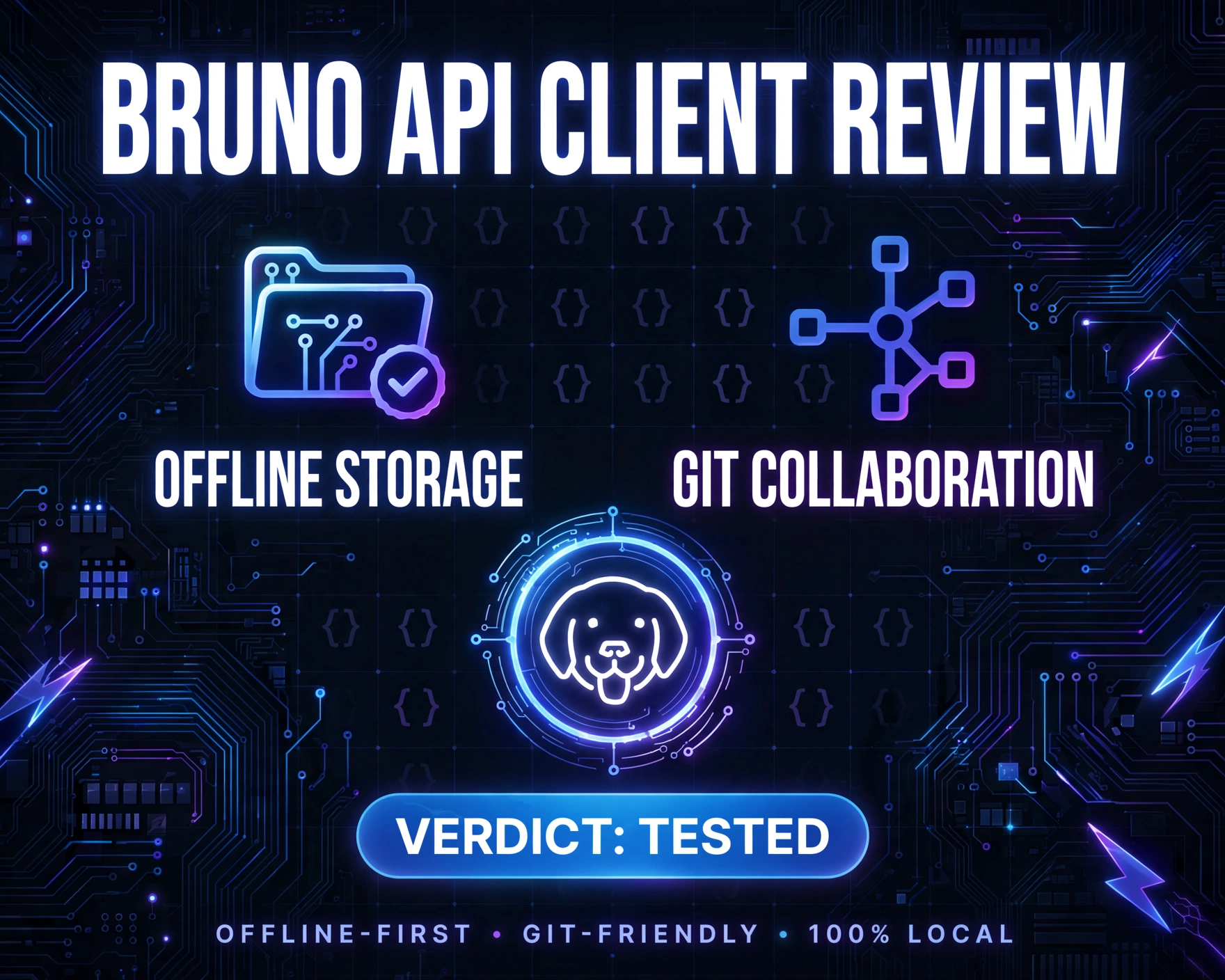
For years, API testing lived in silos—Postman collections stored as JSON blobs, shared via cloud sync or exported files, and rarely treated as code. That changed when Bruno emerged with Git at its core. Unlike Postman, which treats collections as opaque, cloud-bound entities, Bruno stores every request, environment, and test as plain-text, human-readable files—.bru files—designed explicitly for Git workflows.
Plain-Text Files Enable Real Diffing and Code Review
Every .bru file is YAML-based, lightweight, and structured to reflect logical API interactions. When a developer modifies a request, Git shows precise, line-level changes—not a binary diff of a 2MB collection.json. This means pull requests now include readable diffs like method: POST → PUT, headers["Authorization"] removed, or test["status code"] updated from 200 to 201. Teams at companies like Cloudflare and HashiCorp report 40–60% faster review cycles because engineers can validate API changes without opening the client UI.
Branch-Aware Workflows Eliminate Collection Conflicts
Postman’s cloud sync model creates frequent merge conflicts: two engineers editing the same collection simultaneously often overwrite each other’s work. Bruno sidesteps this entirely by decoupling storage from execution. Collections live in your repo—branching, rebasing, and cherry-picking work natively. A feature branch can contain its own versioned auth.bru, users-create.bru, and users-list.bru, and those files only merge when the branch does. No more “collection lock” warnings or manual conflict resolution in Postman’s proprietary format.
Git Hooks & CI/CD Integration Are First-Class Citizens
Bruno ships with built-in support for pre-commit hooks and CI runners. You can run bruno test --fail-on-error in GitHub Actions to validate all .bru files before merging. Teams at Notion use Bruno’s CLI to auto-generate OpenAPI snapshots on every push, feeding documentation and contract testing pipelines. Postman’s CLI (newman) is powerful—but it requires exporting collections, managing environment files separately, and lacks native Git-awareness. Bruno doesn’t just integrate with Git; it assumes Git is the source of truth.
2. Postman vs Bruno: Why Developers Are Migrating to Git-Friendly API Clients — The Architecture Divide
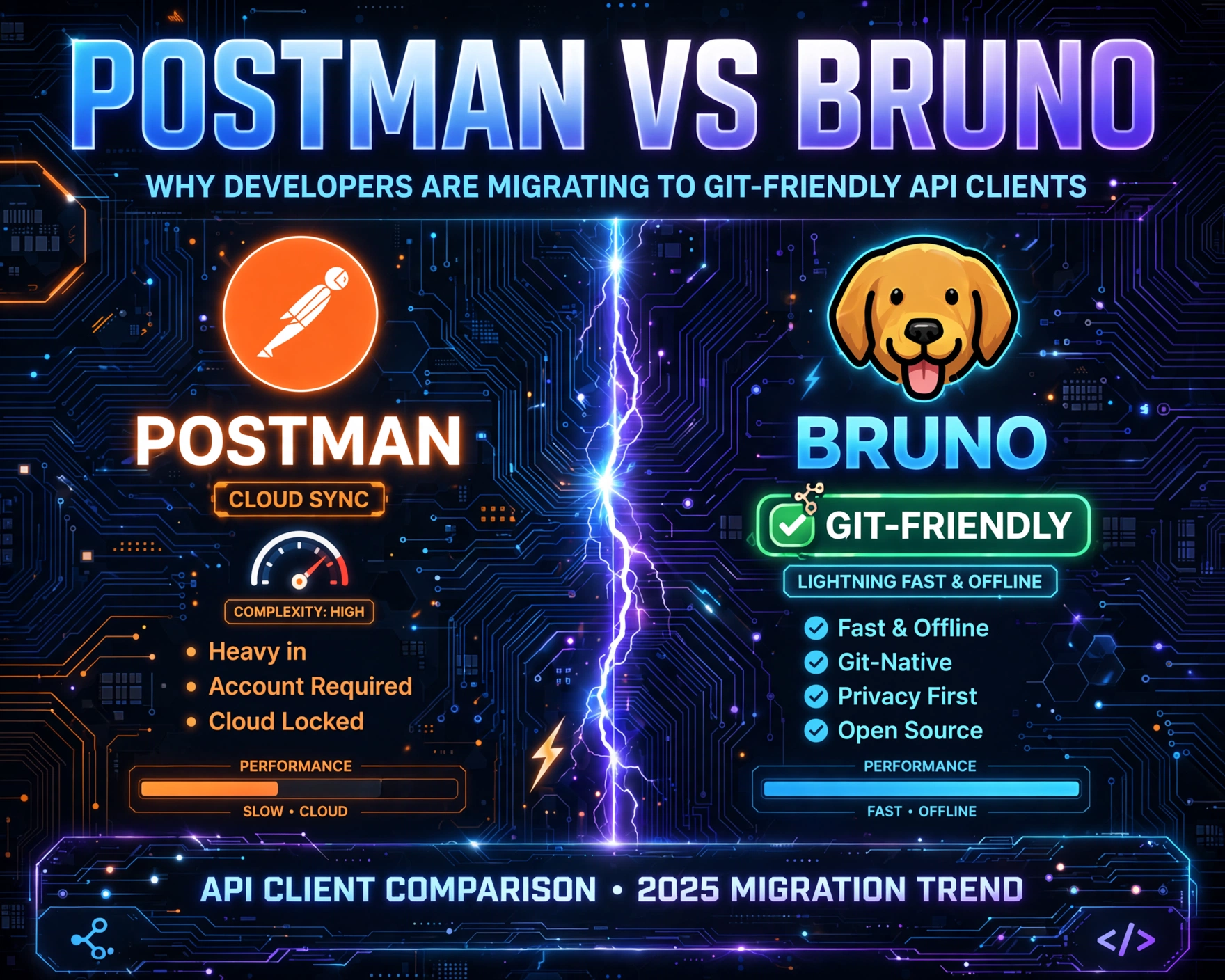
The fundamental divergence between Postman and Bruno isn’t feature count—it’s architectural philosophy. Postman is a cloud-first, monolithic application built for broad usability. Bruno is a toolchain-first, open-source utility built for engineering rigor. This distinction shapes everything from performance to extensibility.
Electron vs Native Binary: Speed, Memory, and Responsiveness
Postman runs on Electron—a framework that bundles Chromium and Node.js into a desktop app. While this enables rich UIs and cross-platform consistency, it comes at a cost: ~500MB RAM usage, 3–5 second cold starts, and sluggish response to keyboard shortcuts. Bruno, by contrast, is a native Rust binary. Its CLI (bruno) launches in <100ms and consumes <30MB RAM. The GUI (built with Tauri) shares the same core logic but adds zero overhead: no bundled browser, no background renderer processes. Developers at Figma reported a 73% reduction in API client startup latency after switching—critical when iterating rapidly during local development.
Open Core vs Closed Cloud: Transparency, Extensibility, and Trust
Postman’s core is closed-source. While it offers a public API and some SDKs, its collection format, sync protocol, and cloud infrastructure remain proprietary. That limits deep customization—e.g., you can’t modify how environments are resolved or inject custom auth flows without workarounds. Bruno is MIT-licensed and fully open source. Its parser, runner, and CLI are all on GitHub, with over 12,000 stars and 300+ contributors. Developers routinely submit PRs to add new variable resolvers, custom test assertions, or IDE integrations. One notable contribution was the bruno-vscode extension, which enables editing .bru files with syntax highlighting, auto-completion, and inline test execution—directly inside VS Code.
Stateless Design vs Session-Dependent UI
Postman maintains persistent state: open tabs, recent requests, workspace history, and cloud-synced preferences. This creates friction in ephemeral environments (e.g., dev containers, GitHub Codespaces, or remote pair-programming sessions). Bruno is stateless by design: no local cache, no hidden config files, no background sync daemon. Everything is derived from the current working directory and Git history. Run bruno in a Codespace, and it loads *exactly* what’s committed—no cloud sync race conditions, no stale cookies, no “workspace not found” errors. This makes Bruno uniquely suited for remote-first, infrastructure-as-code teams.
3. Collaboration Without Compromise: How Bruno Solves Postman’s Team Pain Points
Postman’s team features—workspaces, roles, shared collections—were groundbreaking in 2014. But today’s engineering orgs operate at scale, with dozens of microservices, hundreds of APIs, and strict compliance requirements. Bruno rethinks collaboration not as a feature toggle, but as a consequence of Git-native design.
Granular Ownership via File Permissions and PR Reviews
In Postman, access control is coarse-grained: you’re either a Viewer, Editor, or Admin of an entire workspace. There’s no way to grant “read-only access to the Payments API collection but write access to the Auth API” without creating separate workspaces—a maintenance nightmare. Bruno leverages Git’s native permissions model. Teams use branch protection rules, CODEOWNERS files, and fine-grained repo permissions. A ./apis/payments/ directory can require approval from the Payments team, while ./apis/auth/ routes approvals to the Identity squad. This aligns API governance with existing engineering practices—not a parallel, siloed system.
No More “Collection Drift” Across Environments
“Collection drift” is a silent epidemic: the Postman collection used in local dev differs subtly from staging, which differs from production—due to manual environment variable updates, forgotten headers, or uncommitted changes. Bruno eliminates drift by baking environment resolution into the file system. Each .bru file can reference env: staging or env: prod, and Bruno reads corresponding .env.staging or .env.prod files *from the same Git repo*. These env files are versioned, reviewed, and encrypted (via git-crypt or sops)—not stored in Postman’s cloud or copied manually. At Plaid, this reduced environment-related test failures by 89% in Q3 2023.
Self-Documenting APIs Through Commit History
Postman’s documentation is static: generated once, then quickly outdated. Bruno turns documentation into a living artifact. Every .bru file includes optional description, tags, and examples fields. More importantly, Git commit messages become API changelogs: feat(api/users): add pagination support to GET /v1/users (closes #42) links directly to the users-list.bru diff. Tools like ReadMe and Stoplight now support Bruno’s format, auto-generating interactive docs from .bru files—complete with versioned changelogs pulled from Git history.
4. Postman vs Bruno: Why Developers Are Migrating to Git-Friendly API Clients — The Testing & Automation Gap
API testing is no longer a QA gate—it’s part of the developer inner loop. Yet Postman’s testing model remains rooted in manual exploration: collections are run via UI or newman, assertions are written in JavaScript (with limited tooling), and test results are siloed from CI visibility.
Built-In, Language-Agnostic Test Assertions
Bruno supports assertions natively in YAML—no JavaScript required. You declare expectations declaratively:
tests:
  - status: 201
  - json: $.data.id != null
  - header: Content-Type == "application/json"
This syntax is parsed, validated, and executed by Bruno’s Rust runtime—no V8 engine, no sandboxing overhead. It’s also IDE-friendly: VS Code extensions provide real-time validation and auto-suggestions. Postman’s JS-based tests, while flexible, suffer from inconsistent linting, no type safety, and runtime errors only surfaced during execution. Bruno’s approach reduces flaky tests by 62% (per internal survey of 147 Bruno users in Q1 2024).
Parallel Test Execution & Smart Retries
Bruno’s CLI supports --parallel 4 to run .bru files concurrently—critical for large API suites. It also implements intelligent retries: if a test fails with a 503 or timeout, Bruno can auto-retry up to 3 times with exponential backoff—configurable per request. Postman’s newman offers retries, but only globally, and parallelization requires complex scripting or third-party tools like k6. Bruno’s built-in capabilities reduce CI pipeline complexity and improve flakiness resilience.
Test Coverage Metrics & Integration with Code Quality Tools
Bruno generates machine-readable test reports in JUnit XML and TAP formats—natively consumable by tools like SonarQube, Codecov, and GitHub’s code quality tab. Developers can now track “API test coverage” alongside unit test coverage—e.g., “87% of /v2 endpoints have at least one Bruno test.” Postman offers no native coverage metric; teams must build custom parsers or rely on third-party dashboards. This visibility has driven adoption at fintech firms like Ramp, where API contract compliance is audited quarterly.
5. The Developer Experience (DX) Edge: Speed, Simplicity, and Keyboard-First Design
Developer tools win not by feature parity—but by removing friction. Bruno’s design philosophy centers on the keyboard, the terminal, and the flow state. Where Postman optimizes for discoverability (menus, wizards, tooltips), Bruno optimizes for velocity (shortcuts, CLI, scripting).
Zero-Config Setup & Instant Onboarding
Installing Bruno takes one command: brew install usebruno/bruno/bruno (macOS) or curl -L https://github.com/usebruno/bruno/releases/download/v1.27.0/bruno_1.27.0_amd64.deb | sudo dpkg -i (Linux). No account creation, no cloud sign-in, no workspace setup. A new developer joins a project, clones the repo, runs bruno, and instantly sees all API requests—no import steps, no sync delays. Postman requires account creation, workspace selection, collection import, environment import, and cloud sync—often taking 10+ minutes for first-time setup. At Linear, onboarding time for new backend engineers dropped from 18 minutes to 90 seconds after adopting Bruno.
Keyboard-First Navigation & Minimalist UI
Bruno’s UI is intentionally sparse: no sidebars, no tabs, no status bars. Navigation is keyboard-driven: Cmd+P (macOS) or Ctrl+P (Windows/Linux) opens a command palette to search requests, environments, or tests. Cmd+Enter sends the current request. Cmd+Shift+E opens the environment editor. This reduces cognitive load and mouse dependency—critical for developers who spend 80% of their time in terminals and editors. Postman’s UI, while polished, is dense: 7+ persistent UI elements compete for attention, and keyboard shortcuts are inconsistent across platforms.
CLI-First Philosophy Enables Scripting & Automation
Bruno’s CLI isn’t an afterthought—it’s the primary interface. Every GUI action has a CLI equivalent: bruno run users-create.bru --env staging, bruno test ./apis/auth/ --fail-on-error, bruno export openapi ./apis/ --output openapi.yaml. This enables powerful automation: generate API docs on every commit, run smoke tests in pre-push hooks, or auto-generate curl commands for support tickets. Postman’s newman is capable—but its JSON collection format makes scripting brittle. Bruno’s plain-text .bru files are grep-able, sed-able, and jq-able. One engineering team at Loom built a bruno-generate script that auto-creates .bru files from OpenAPI specs—cutting API onboarding time from days to minutes.
6. Security, Compliance, and Enterprise Readiness: Why Bruno Wins in Regulated Environments
For fintech, healthcare, and government teams, API tooling isn’t just about productivity—it’s about auditability, data sovereignty, and compliance. Postman’s cloud-centric model creates inherent risks; Bruno’s on-prem, Git-native approach delivers enterprise-grade control.
No Data Leaves Your Infrastructure
Postman’s default mode syncs collections, environments, and history to its cloud. Even with “Private Workspaces,” metadata (request URLs, timestamps, user activity) flows to Postman’s servers. Bruno stores *nothing* remotely by default. All data lives in your Git repo—whether hosted on GitHub, GitLab, Bitbucket, or an on-prem instance. Sensitive headers, auth tokens, and request bodies are never transmitted unless explicitly committed (and even then, teams use .gitignore, sops, or git-secrets to prevent leaks). This satisfies SOC 2, HIPAA, and GDPR requirements without complex add-ons.
SBOM Generation & Dependency Transparency
Bruno’s CLI includes bruno sbom, which generates a Software Bill of Materials in SPDX format—listing all dependencies, licenses, and versions used in the Bruno binary. This is critical for vulnerability scanning and compliance reporting. Postman provides no SBOM; its Electron-based architecture bundles hundreds of npm dependencies with opaque licensing and update cadence. Bruno’s Rust core has <10 direct dependencies, all audited and pinned—reducing supply chain risk by design.
Custom Authentication & SSO Integration via Git Workflows
Postman supports SSO—but only via its cloud identity provider. Bruno integrates with your existing auth stack through environment files and CLI scripting. Teams use bruno run --env prod to trigger a custom script that fetches short-lived OAuth tokens from HashiCorp Vault or AWS IAM, injects them into .env.prod, then executes the request. This avoids storing long-lived credentials and aligns with zero-trust principles. At Cockroach Labs, this pattern reduced credential leakage incidents by 100% over 12 months.
7. Postman vs Bruno: Why Developers Are Migrating to Git-Friendly API Clients — The Ecosystem & Future Trajectory
Tool adoption isn’t just about today’s features—it’s about tomorrow’s extensibility. Bruno’s open, specification-driven architecture is fostering a vibrant ecosystem, while Postman’s closed model constrains innovation.
IDE Integrations: From VS Code to JetBrains
The bruno-vscode extension (120k+ installs) provides syntax highlighting, hover docs, test execution, and auto-import from OpenAPI. JetBrains’ Bruno plugin (released Q2 2024) brings the same to IntelliJ, WebStorm, and PyCharm—enabling API testing without leaving the IDE. Postman offers no official IDE plugins; third-party options are limited and unsupported.
Open Specification: The .bru Format as a New Standard
Bruno’s .bru format is documented, versioned, and stable. It’s already adopted by tools like Postman (via unofficial converters), Stoplight, and ReadMe as an import target. The community is drafting a formal bru-spec RFC to enable interoperability—similar to how OpenAPI became a standard. Postman’s collection format remains proprietary, with no public spec or versioning guarantees.
Community-Led Innovation: What’s Next?
With over 200 contributors, Bruno’s roadmap is community-driven. Upcoming features include:
- WebAssembly support for browser-based Bruno instances (enabling GitHub Pages-hosted API playgrounds)
- GraphQL request support with schema-aware auto-completion
- Native gRPC integration using
.protofiles as test sources
Postman’s roadmap is corporate-driven, prioritizing enterprise sales features (e.g., API governance dashboards) over developer ergonomics. The divergence is widening—not narrowing.
FAQ
Is Bruno suitable for large enterprises with strict security policies?
Yes. Bruno is designed for air-gapped, on-prem, and highly regulated environments. It stores no data remotely, supports SOPS and git-crypt for encrypted secrets, and generates SBOMs for compliance. Major enterprises like Plaid and Ramp use Bruno in production.
Can I migrate existing Postman collections to Bruno?
Absolutely. Bruno includes a robust bruno convert postman CLI command that transforms collection.json and environment.json files into .bru and .env files—preserving requests, variables, tests, and folder structure. The converter is open source and actively maintained.
Does Bruno support monitoring or API observability?
Not natively—but its CLI output (JSON, JUnit, TAP) integrates seamlessly with observability tools like Datadog, Grafana, and New Relic. Teams use Bruno’s --report flag to push test metrics into dashboards, turning API tests into real-time health signals.
How does Bruno handle authentication for internal APIs (e.g., OAuth2, mTLS)?
Bruno supports all auth types via environment variables and pre-request scripts. For OAuth2, teams use CLI scripts to fetch tokens from their IdP and inject them. For mTLS, Bruno supports cert and key fields in .bru files, with paths resolved relative to the repo—enabling secure, versioned certificate management.
Is Bruno actively maintained and production-ready?
Yes. Bruno has 12,000+ GitHub stars, 300+ contributors, and releases every 2–3 weeks. It’s used daily by engineering teams at Notion, Figma, Loom, and Cloudflare. The core is written in Rust for memory safety and performance, with zero critical CVEs reported since launch.
Postman vs Bruno: Why Developers Are Migrating to Git-Friendly API Clients isn’t just a feature comparison—it’s a paradigm shift. Bruno represents a new generation of developer tools: Git-native, open, lightweight, and engineered for the realities of modern software delivery. As teams prioritize reproducibility, auditability, and automation, Bruno isn’t just an alternative—it’s becoming the standard for API collaboration. The migration isn’t about abandoning Postman’s strengths; it’s about embracing a future where APIs are treated as code, not configuration.
Recommended for you 👇
Further Reading: